
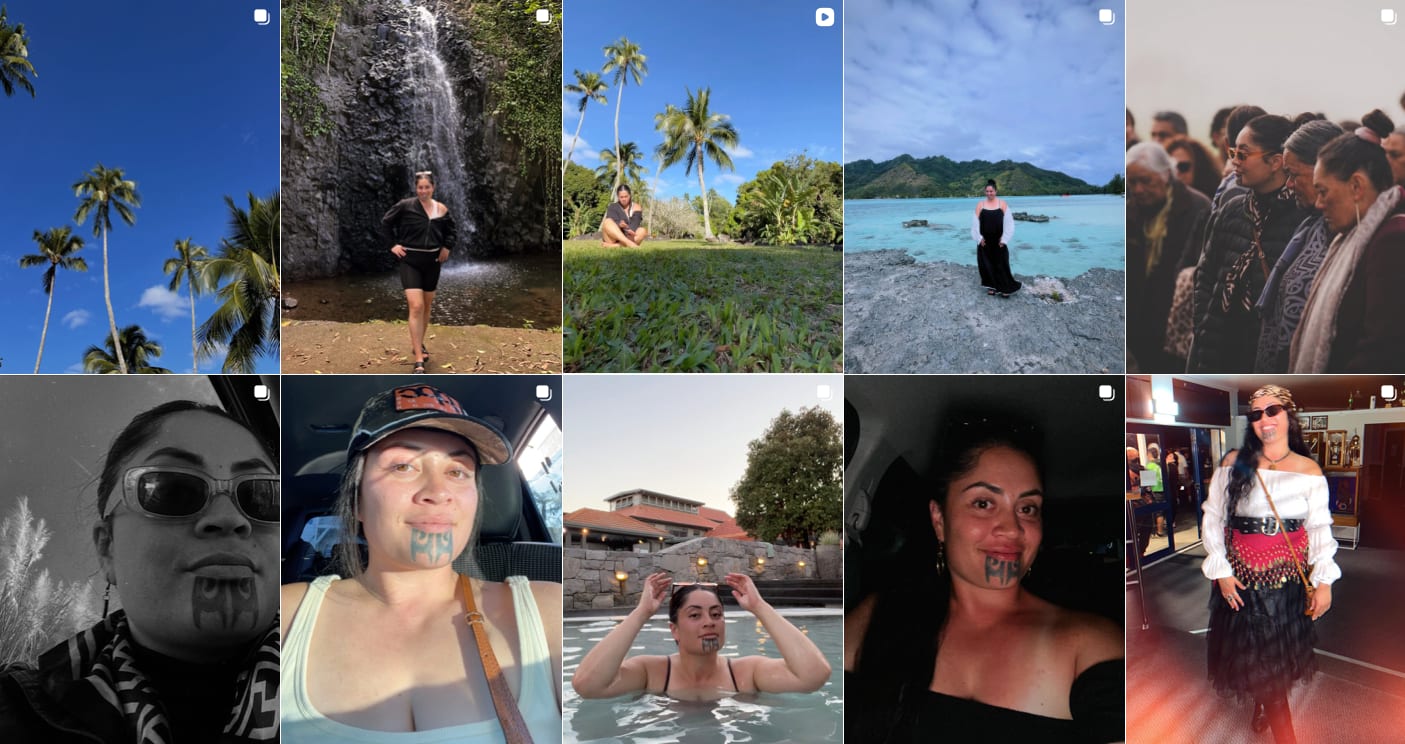
Rangiātea Stewart would never promote online gambling. But that did not stop scammers from using her face to do it for her.
Her experience exposes how trusted Māori faces are being taken from social media and used to draw whānau towards online casinos.
Stewart found out when people she had never spoken to began sending her screenshots and asking whether the advertisements were real.
Her photographs had been published under a different name and attached to a fabricated personal story designed to lead people to an online gambling website.
“My face, my photos had been taken and used for these scams,” Stewart says.
The accounts behind the advertisements had blocked her, preventing her from seeing where or how her images were being used.
She warned her followers that the advertisements were fake and reminded them she would never message anyone encouraging them to gamble.
“I asked them to screenshot the pages or send me the links to those fake pages and made posts on my own social media platforms warning anyone and everyone on my pages,” she says.
“I gave everyone steps, telling them to report the page for false advertising and then message them warning them that I’m aware this is happening.”
Last year, Hāpai Te Hauora warned that offshore online casinos were using Māori influencers and other trusted Māori faces to reach whānau through social media.
We said the targeting was calculated and manipulative and called for stronger controls on gambling advertising, influencer marketing and the use of people’s identities without their consent.
As more fake accounts and advertisements appeared, whānau began contacting us to say their photographs had been taken and used without permission.
Stewart was one of them.
“This was my face on the line, and I did not want it to be associated with any kind of gambling company,” she says.
Long before her image was used without her consent, Stewart had already turned down offers of between $10,000 and $20,000 to promote online gambling through her own platforms.
“I know people who promote gambling companies. I have nothing against them, but I could never do it,” she says.
Her refusal was grounded in her own experience of gambling harm.
Stewart remembers waiting in the car for hours, not knowing when she would be going home. She was asked for money, had to navigate mood swings and later discovered her V1 Waka Ama was used to settle a matter without her knowledge.
When Stewart became hapū, she decided her tamariki would not experience the same things she had.
“I didn’t want my tamariki to go through what I went through, and made that very clear,” she says.
“Those were the sacrifices and boundaries I was willing to put up and take if it meant my kids having a different upbringing.”
A changing online gambling landscape
Stewart’s experience comes as the online gambling environment in Aotearoa is changing.
The Online Casino Gambling Act came into force on 1 May 2026, creating a licensing system for up to 15 online casino operators. The system is being introduced in stages, with licensed casinos expected to begin operating in 2027.
Online casino operators are not yet permitted to advertise while the licensing process is underway. Once licensed, however, they will be able to advertise within rules set by the new law.
For Hāpai Te Hauora, Stewart’s experience shows what is at stake.
We remain concerned that allowing licensed operators to advertise will increase the visibility of online gambling and make it appear safer or more legitimate to whānau.
Her story also shows how easily trust can be exploited online, particularly when Māori faces, identities, and personal experiences are used to reach Māori audiences.
Regulating online casinos is not the same as preventing harm.
Strong advertising controls, effective limits and self-exclusion that work across all operators, and accountability for preventing harm will be needed if whānau are to be protected from further harm.
If you see an advertisement using someone’s identity without their consent, do not click the link. Take a screenshot, report the advertisement and fake account, and let the person being impersonated know.
Learn more about online gambling harm at gamblingharm.nz.
Free kaupapa Māori information, tools and support are available through Pātea at patea.nz.